
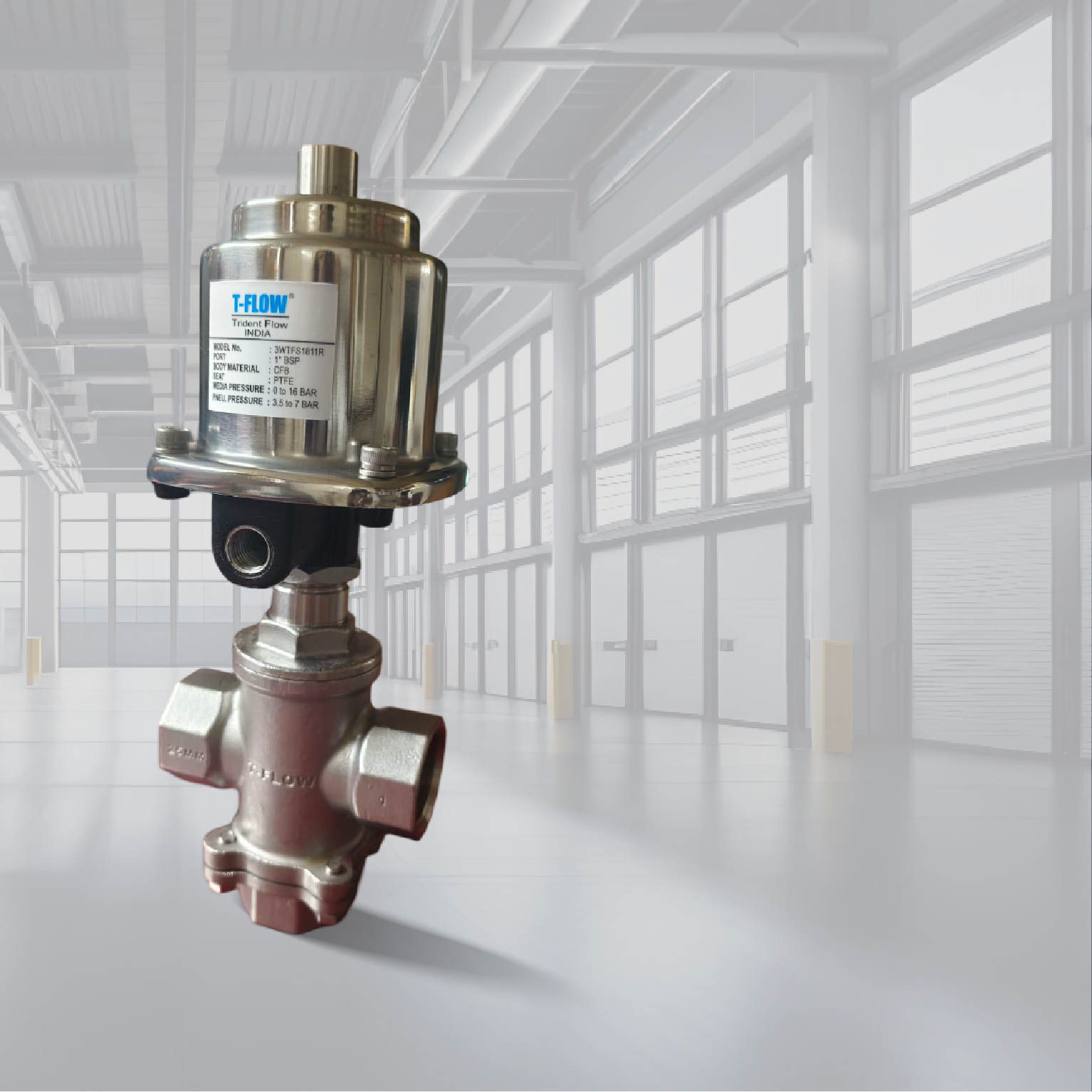
Mixing Diverting Valve 3WTFCS251SQ for Temperature Control Loops
Optimizing temperature control loops in industrial processes is crucial for efficiency, product quality, and operational safety. A key component in achieving this precision is the 3-way mixing or diverting valve. Trident Flow Controls offers the robust 3WTFCS251SQ model, a versatile solution designed to meet the demanding requirements of various sectors, from chemical processing to HVAC systems.
This article delves into the capabilities of the 3WTFCS251SQ valve, exploring its role in temperature regulation, its applications across different industries served by Trident Flow Controls, and the critical factors to consider when selecting such a vital piece of equipment for your control loops.
Understanding the 3-Way Mixing Diverting Valve
A 3-way control valve is characterized by its three ports, allowing it to perform two primary functions: mixing two incoming fluid streams into a single outlet or diverting a single incoming stream into one of two possible outlets. The specific configuration of the valve's internal ports determines its suitability for mixing or diverting tasks.
Mixing applications, also known as converging applications, are essential for precisely blending fluids. A common example is the blending of hot and cold water to achieve a specific target temperature, such as in HVAC systems or industrial heating and cooling processes. In chemical and pharmaceutical industries, mixing valves ensure the correct ratios of reactants or ingredients are combined, maintaining product consistency and reaction efficacy.
Diverting applications, or diverging applications, involve directing a single flow path to one of two separate destinations. This is useful for routing process streams to different tanks, switching between active and standby equipment, or bypassing certain components like heat exchangers for maintenance or control purposes. The 3WTFCS251SQ, by Trident Flow Controls, is designed to execute these functions with accuracy and reliability.
The Crucial Role of the 3WTFCS251SQ in Temperature Control Loops
Temperature control is a cornerstone of many industrial operations. In closed-loop control systems, a 3-way valve like the 3WTFCS251SQ plays a pivotal role in modulating fluid temperature to maintain a setpoint. When used in a mixing configuration, the valve precisely blends a hot fluid stream with a cold fluid stream to achieve the desired output temperature. For instance, in an AHU (Air Handling Unit) HVAC system, it can blend hot and chilled water to regulate the air supply temperature.
Alternatively, in a diverting configuration, the valve can be strategically placed to control flow through a heating or cooling coil. By directing fluid either through the coil or bypassing it, the valve modulates the amount of heat transfer. This diverting strategy can sometimes offer tighter temperature control and quicker response times compared to mixing applications, as it directly influences the supply fluid temperature and minimizes the lag associated with blending. The automated nature of valves like the 3WTFCS251SQ, often integrated with PLC (Programmable Logic Controller) systems, allows for real-time adjustments based on sensor feedback, ensuring the temperature remains within tight tolerances.
The 3WTFCS251SQ from Trident Flow Controls is engineered to provide the necessary responsiveness and accuracy for these dynamic temperature regulation tasks. Its ability to precisely manage flow paths ensures that energy is used efficiently and that process parameters are consistently met.
Diverse Applications Served by Trident Flow Controls
Trident Flow Controls leverages its expertise to provide solutions like the 3WTFCS251SQ valve to a wide array of critical industries. The versatility of this 3-way valve makes it suitable for numerous applications:
Temperature Regulation
Used in HVAC systems, industrial process heating/cooling, and chemical blending for precise temperature management.
Water Treatment & Management
Controlling flow in water and wastewater treatment plants for efficient distribution and mixing of treatment chemicals or process water.
Chemical & Dyes Processing
Essential for blending chemicals, controlling reaction temperatures, and diverting process streams in the chemical and dyes industries.
Pharmaceutical & Process OEM
Ensuring accurate mixing or diversion in pharmaceutical production, and as a component in machinery for process OEMs.
Oil & Gas and Defence
Applied in various control loops for fluid management and temperature regulation within the oil sector, oil and gas operations, and defence applications.
Refrigeration & Chilling
Integral to compressor and chilling systems, managing refrigerant flow or cooling medium for precise temperature control.
Key Benefits Offered by the 3WTFCS251SQ Valve
Implementing the 3WTFCS251SQ mixing diverting valve from Trident Flow Controls brings significant advantages to industrial operations:
- Enhanced Process Control: Provides precise modulation of fluid flow for accurate temperature regulation, critical for product quality and consistency.
- Increased Efficiency: Optimizes energy usage by ensuring fluid temperatures are maintained at setpoints, reducing waste and operational costs.
- Simplified System Design: A single 3-way valve can often replace multiple 2-way valves, reducing piping complexity, potential leak points, and overall system footprint.
- Reliability and Durability: Built to withstand demanding industrial environments, ensuring long-term performance and minimal downtime.
- Automation Integration: Designed for seamless integration with automated control systems (like PLCs), enabling real-time adjustments and remote monitoring.
- Versatility: Capable of performing both mixing and diverting functions, making it adaptable to a wide range of applications.
Trident Flow Controls' commitment to providing engineered solutions is evident in the design and capabilities of the 3WTFCS251SQ.
Selecting the Right Mixing Diverting Valve
Choosing the appropriate 3-way valve is critical for the success of your temperature control loop. Consider the following factors when evaluating options, including the 3WTFCS251SQ from Trident Flow Controls:
Buyer Insight:
Understand whether your application primarily requires precise blending (mixing) or flow routing (diverting). While some valves can perform both, their optimal performance may be in one function over the other. The internal port design significantly impacts this capability.
| Consideration | Details for Selection |
|---|---|
| Application Type | Determine if mixing or diverting is the primary need. T-port valves are often favored for mixing, while L-port suits diverting, though specific designs vary. |
| Process Fluid Properties | Consider viscosity, temperature range, chemical compatibility, and presence of solids that could affect valve performance and material selection. |
| Required Flow Rate & Control Accuracy | Assess the maximum flow rates and the precision needed for temperature control. Valves with higher CV ratings generally offer lower resistance and higher efficiency. |
| Control System Integration | Ensure the valve actuator (pneumatic or electric) and control signal compatibility align with your existing automation and PLC systems. |
| Pressure and Temperature Ratings | Verify that the valve's operational pressure and temperature limits exceed the maximums expected in your system. |
| Maintenance and Serviceability | Look for designs that facilitate easy maintenance, such as accessible internal components or external bypass structures. |
Questions to Ask Before Buying
To ensure you procure the most suitable valve, engage with your supplier by asking pertinent questions:
What are the typical maintenance intervals for this valve model?
Understanding maintenance schedules helps in planning operational downtime and ensuring longevity.
Can this valve be configured for both mixing and diverting applications effectively?
Clarify the valve's primary strength and its capability in secondary functions.
What are the recommended installation and commissioning procedures?
Proper installation is key to optimal performance and system reliability.
What level of automation and control signal compatibility can be expected?
Ensure seamless integration with your plant's control infrastructure.
What industries or specific applications has this valve model been successfully deployed in previously?
Gaining insight into past successes can build confidence in its suitability for your needs.
Leveraging Trident Flow Controls' Capabilities
Trident Flow Controls specializes in delivering robust flow control solutions tailored to the needs of diverse industries. With capabilities spanning project engineering, turnkey project execution, and automation design, the company is well-equipped to support your complex process requirements.
For applications requiring precise temperature control loops, the 3WTFCS251SQ mixing diverting valve stands as a testament to their product offerings. Whether you operate in the Oil Sector, AHU HVAC SYSTEMS, CHEMICALS, DYES & PIGMENTS, OIL AND GAS, PHARMACEUTICAL AND PROCESS OEM, REFRIGERATION COMPRESSOR AND CHILLING INDUSTRY, WATER & TREATMENT PLANTS, or the Defence Sector, Trident Flow Controls possesses the professional team and onsite commissioning expertise to ensure your systems perform optimally.
By understanding your unique operational challenges, Trident Flow Controls can help identify and implement the most effective flow control strategies, ensuring reliable performance and efficient operations.
Frequently Asked Questions
What is the primary difference between a mixing and a diverting valve?
A mixing valve combines two fluid streams into one outlet, typically for temperature control. A diverting valve takes a single inlet stream and directs it to one of two possible outlets, used for routing or bypassing.
Can a single 3-way valve be used for both mixing and diverting?
Yes, many 3-way valves are designed to perform both functions. However, their internal port configuration (e.g., T-port vs. L-port) might make them more efficient or suitable for one application over the other.
How does a 3-way valve contribute to tighter temperature control?
By precisely modulating the flow of hot and cold fluids (mixing) or by controlling flow through a heat exchanger (diverting), a 3-way valve allows for finer adjustments to achieve and maintain a desired temperature setpoint.
Why is automation important for mixing diverting valves in control loops?
Automated valves integrate with control systems to make real-time adjustments based on process feedback (like temperature readings), ensuring consistent performance and eliminating manual intervention.
What industries commonly use 3-way valves for temperature control?
Industries such as HVAC, chemical processing, pharmaceuticals, food and beverage, power generation, and oil and gas frequently utilize 3-way valves for precise temperature management in their processes.
Request Your Tailored Flow Control Solution
Ensure optimal performance and efficiency in your temperature control loops with the advanced 3WTFCS251SQ mixing diverting valve from Trident Flow Controls. Our team is ready to assist you in selecting and implementing the ideal solution for your specific industrial application.
Contact Us Today